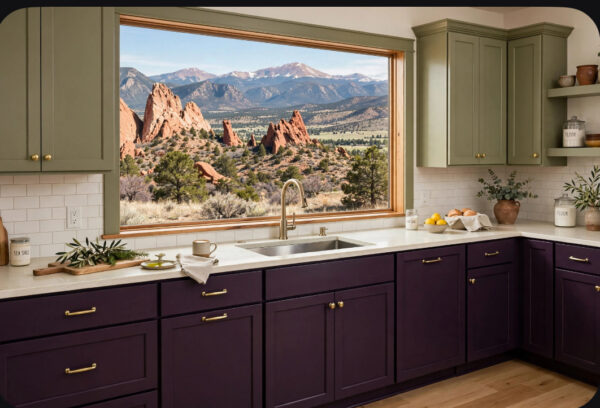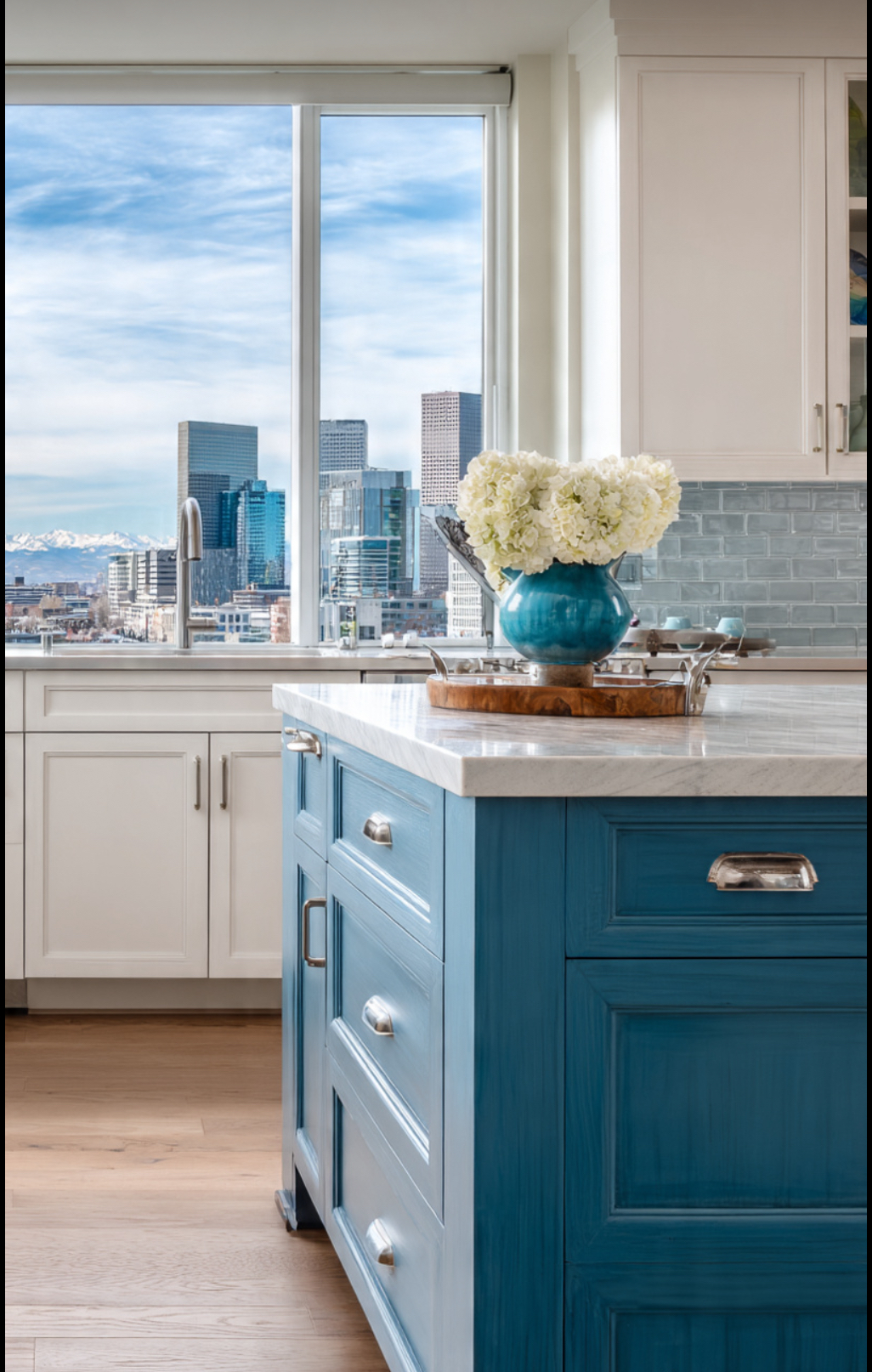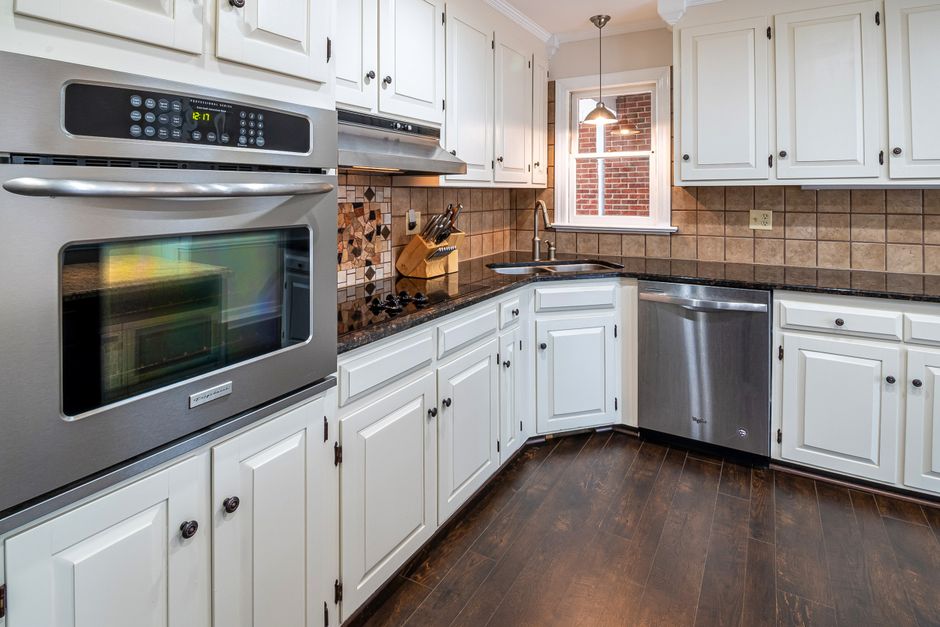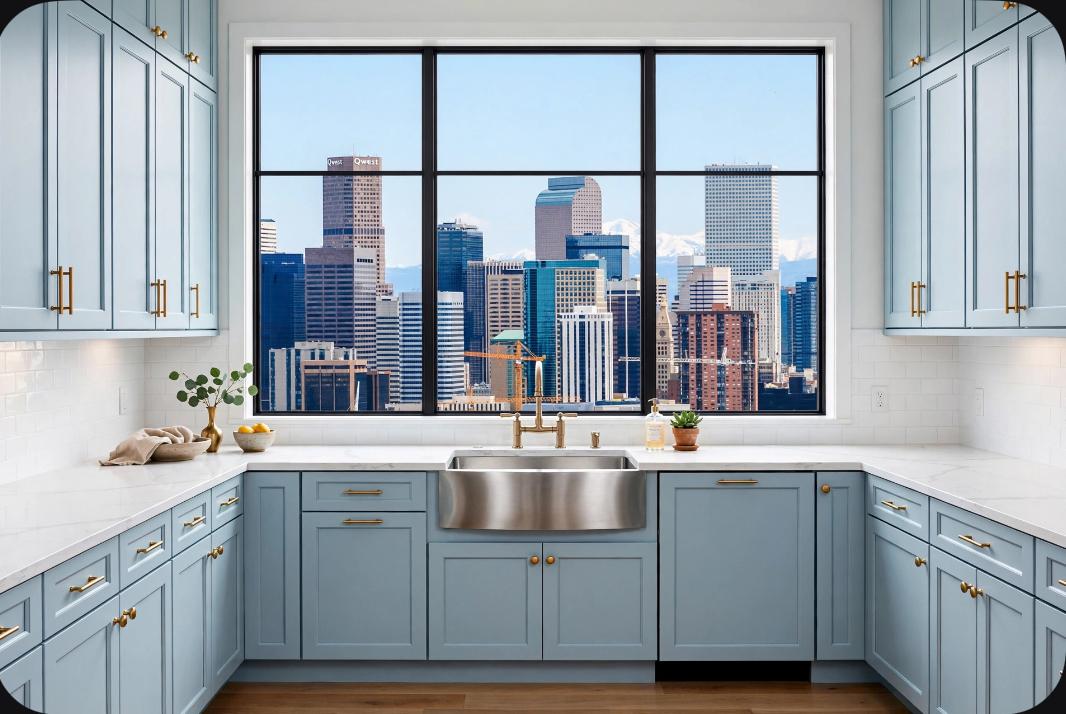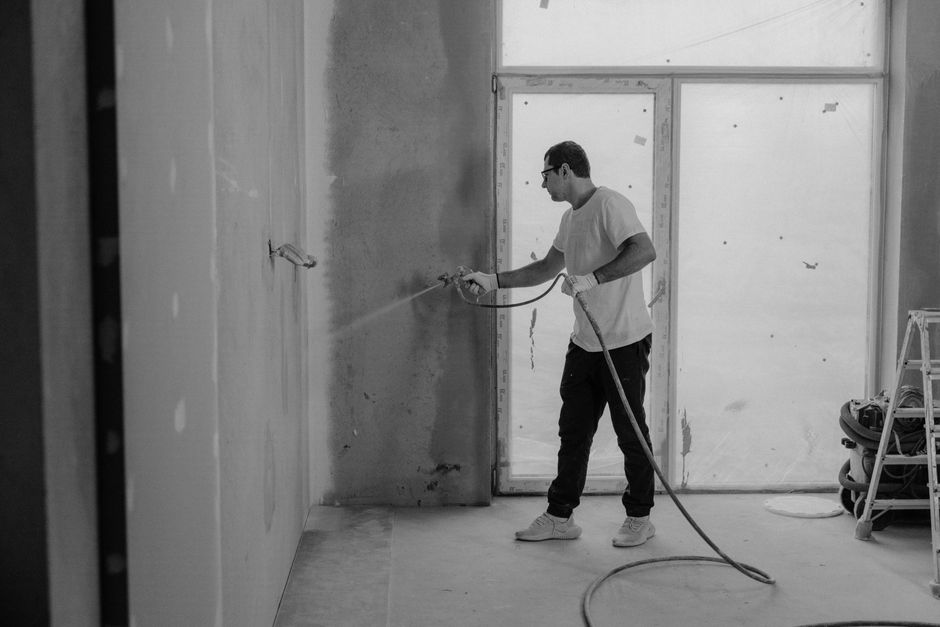
Most homeowners in Denver County start this project with a color in mind and no idea that color is the easy part. The hard part is the film that sits on the door. A kitchen cabinet door gets grabbed, wiped, bumped by a trash bag, splattered with bacon grease, and closed with a hip while both hands are full. The finish has to survive that for years without turning gummy, chipping at the edges, or going shiny in the spots everyone touches. That is why we do not brush latex on cabinets, and why the products we spray are the reason our clients stop thinking about their cabinets once the job is done.
The System in One Sentence
We use pre-catalyzed lacquer primers and acrylic topcoat finishes that harden like a lacquer paint providing a satin finish. That is the whole recipe. Every other decision, the sanding, the spray booth, the dry time, the re-install, exists to let those two products do their job. This is the same category of finish found on $50k new cabinets, which is why we can hand a homeowner a kitchen that looks like it came out of a cabinet shop rather than a paint aisle.
What Pre-Catalyzed Lacquer Primer Does for Wood
A primer on a cabinet door is doing four jobs at once: bonding to the wood, sealing the grain, blocking anything underneath from bleeding through, and giving the topcoat a surface it can lock onto. The pre-catalyzed lacquer primer Denver cabinet shops favor for this work handles all four better than a general purpose wall primer because the catalyst is mixed in during manufacturing, so the film cures harder and more evenly than an air-dry product. It also sprays on more evenly, covers flaws, and hides previous stains, which matters on kitchens that spent thirty years as stained oak.
Adhesion: Gripping the Door Instead of Sitting on It
After dustless HEPA sanding opens the surface, the primer is sprayed on and mechanically keys into the grain. Wall paint sits on top of a sealed surface and relies on being sticky. A catalyzed primer bites. On a Denver bungalow with fifty-year-old oak doors, this is the difference between a finish that lifts at the edges within a year and one that stays put.
Blocking Tannins and Old Stain
Oak, and stained oak especially, holds pigments and natural tannins that want to migrate up through a new finish. If they come through, you get a brown ghost under a white door, and there is no fixing that without starting over. The pre-catalyzed primer seals it in, which is one reason we can take a dark 1990s kitchen to a clean white without stripping the wood back to bare.
Sealing the Grain for a Level Surface
Open grain oak has pores. Left open, they telegraph through the topcoat and the door reads as rough, even when the color is perfect. Primer fills and levels those pores so the topcoat can lay down flat. That flat base is what makes a satin sheen look like a finish instead of a texture.
Acrylic Topcoat That Hardens Like Lacquer
An acrylic topcoat cabinet finish is where the durability lives. Ours is an acrylic that crosslinks as it cures and ends up hard, the way a lacquer paint does, rather than staying soft and rubbery the way wall paint is designed to. Industrial wood coatings such as waterborne 2K polyurethanes or catalyzed lacquers offer superior durability compared to standard coatings, and this system sits in that family.
How It Differs From Latex Wall Paint
Latex wall paint is engineered to stay flexible because walls move, shift, and settle, and a brittle film on drywall would crack. Cabinets are the opposite situation. They are dimensionally stable and they get touched constantly. A flexible film on a high-touch surface can scuff, stay soft under a fingernail, and collect grime in its texture. That is why house painters who brush latex on cabinets, as many do, get a result that cannot withstand the daily rigors of a high-traffic home.
Why Hardware Store Enamel Is a Different Category
An off-the-shelf enamel in a quart can is still a consumer coating. It may be tougher than wall paint, but it is not the same class of product as an industrial wood coating sprayed in a controlled shop. The store-bought route also comes with a brush, which means brush marks, lap lines at the stiles, and dust landing in a wet film while it dries in your kitchen.
Holding Color Instead of Yellowing
Older solvent lacquers earned a reputation for going amber over time, and whites were the worst case. The acrylic topcoat we spray is formulated to hold its color, so a white or light gray kitchen in Denver County keeps the tone you picked instead of drifting toward yellow in the sunniest spots near the windows.
Why Satin Is the Right Sheen for a Denver Kitchen
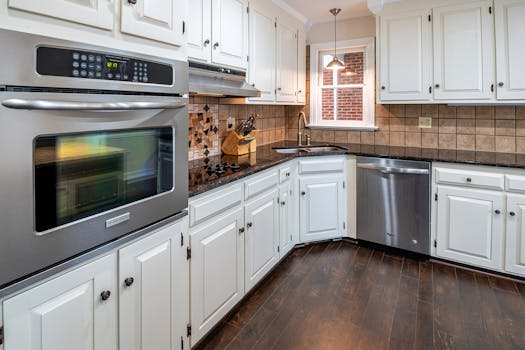
Satin is the middle ground most kitchens land on, and for good reasons. It is not glossy enough to broadcast every fingerprint, splash, and smudge, and it is not flat enough to look chalky or grab onto grime. A flat finish on a door near a range hood becomes a maintenance project. A high gloss door will show every streak from a sponge and every bit of grease film. Satin reads as clean with less effort.
There is a design argument too. Satin gives a soft sheen that shifts as you walk past, so the doors catch light without turning into mirrors, and minor imperfections in the wood stop drawing attention. It is the sheen that makes a painted kitchen look custom rather than refinished. We spray clear lacquer in the sheen of your choice, and satin is the one we recommend most often in Denver homes.
Built for Denver County Conditions
Denver’s air is dry, the altitude is high, and homes swing between heated indoor air in winter and open windows in summer. That movement is hard on wood and hard on finishes that never fully cure. A hard, fully cured film handles it better than a soft one, and a primer that seals the substrate keeps the wood from absorbing and releasing moisture as fast. In a Denver bungalow where the original doors have already moved a little, that stability is worth something.
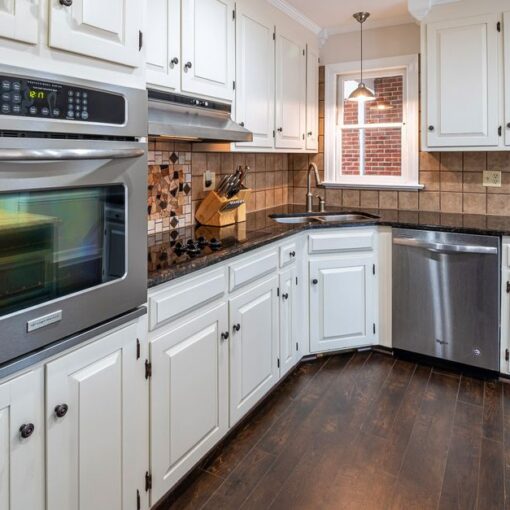
Denver new builds have their own set of issues. Builder-grade cabinets are often finished with something thin and easily scuffed, and the color palettes are aggressively neutral. Those kitchens respond well to a sprayed system because the boxes are square and the doors are flat, which is exactly the geometry a shop-sprayed finish flatters. Older Denver County homes with paneled doors and layered trim take more prep and more primer, but they take the finish beautifully too.
How We Spray It: A Dust-Free Shop and a Factory Finish
The equipment and the environment matter as much as the can. This is the process on a typical Denver job.
- We mask off the work area to protect your home and family.
- Doors and drawer fronts are removed and taken to our dust-free shop.
- Faces and boxes are prepped with dustless HEPA sanding.
- We spray multiple coats of tinted pre-catalyzed lacquer on the doors and boxes.
- We spray clear lacquer in the sheen of your choice, then re-install everything.
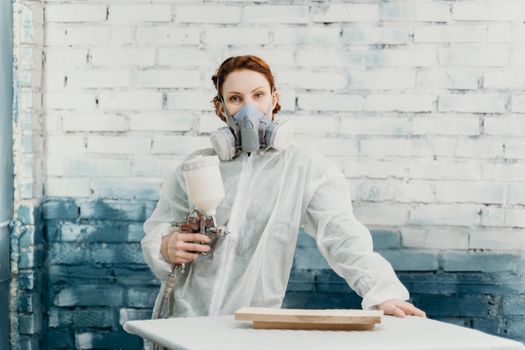
Hand brushing on site cannot match this. A brush cannot lay a film as level as a spray gun, dust is always in the air of a working home, and the person brushing your doors is standing in your kitchen rather than in a booth built for the job. Most of our Denver projects run in the five to seven day range, and every job carries a three-year workmanship warranty.
Durability Comparison: Lacquer-Hard Finish, Latex, and 2K Polyurethane
Two industrial systems show up in professional cabinet work. Here is how they sit next to the brushed latex approach.
| What matters | Brushed latex house paint | Pre-catalyzed lacquer primer + acrylic topcoat | Waterborne 2K polyurethane |
|---|---|---|---|
| Where it is applied | On site, in your kitchen | Sprayed in a dust-free shop | Sprayed in a dust-free shop |
| Film behavior | Stays flexible, made for walls | Hardens like lacquer | Very hard industrial film |
| Durability | Lower than industrial coatings | Superior to standard coatings | Superior to standard coatings |
| Sheen control | Limited | Clear lacquer in the sheen of your choice | Varies by product |
| Our standard | Not used on cabinets | Yes, this is our system | Offered on select projects |
Both industrial options outperform standard consumer coatings. The reason we standardize on the pre-catalyzed lacquer primer with an acrylic topcoat comes down to control. It gives us a predictable satin sheen with depth, it holds color, and it sprays clean in the booth. That is the factory finish Denver clients are actually paying for, not just a color. If a project calls for something different, we say so before we start rather than after.
Cleaning and Maintaining a Satin Lacquer-Hard Finish
A hard finish is easy to live with because it does not trap dirt in a soft surface. A few habits keep it looking new.
- Wipe everyday marks with a soft damp cloth and a little mild dish soap.
- Skip abrasive pads, scrubbing sponges, and anything labeled as a heavy degreaser.
- Clean up grease near the range and hood before it bakes on.
- Let the finish reach full cure before heavy use, and follow the cure guidance you are given at install.
- No wax and no polish. The sheen is built in.
Around the hardware, expect normal wear at the pull or knob from daily contact. That spot takes the most handling in any kitchen, which is one more reason a hard film beats a soft one. Lacquer-hard cabinet paint resists the burnishing that turns softer finishes shiny at the touch points.
Where This System Works Best in Denver Homes
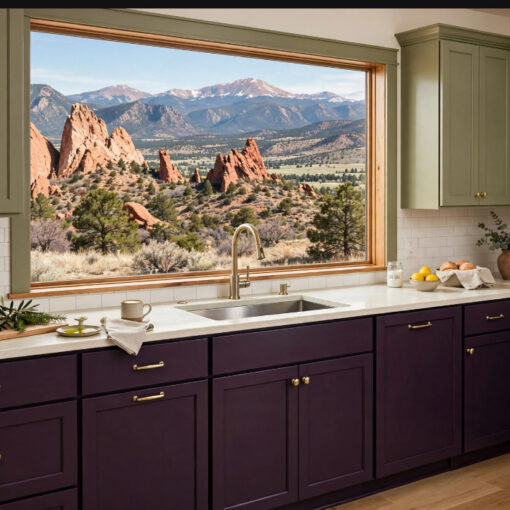
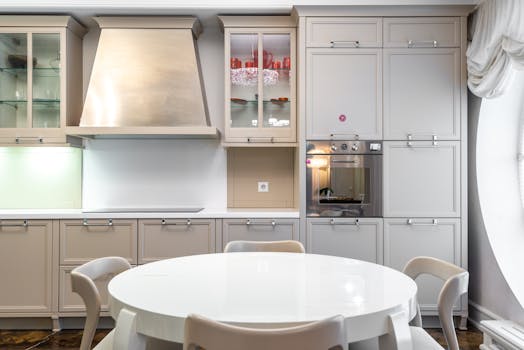
Any cabinet handled daily is a candidate. Kitchen cabinets are the obvious one. Bathroom vanities are second because they live in a humid room and get wiped constantly. Two-tone kitchens, where the uppers are one color and the lowers another, are another good fit, since both colors get the same film and the same sheen. Older Denver bungalows with oak doors and stained finishes are where the primer earns its keep, and newer Denver builds finally get a finish that matches the rest of the house.
The first thing we do is look at what is on the cabinets now. Existing lacquer, factory finishes, and painted surfaces all behave differently, and the prep and primer plan changes with them. That is a conversation for the estimate, not a guess from a photo.
Get a Sample Door in Satin
Reading about a finish is not the same as holding one. For satin finish cabinet painting Denver County homeowners can inspect in person, we will finish a sample door in the satin lacquer-hard system so you can see the sheen in your own light and run a fingernail across it before you commit to anything. Visit cabinetspainting.com to request your free estimate and ask for the sample. We work in Denver, in the City and County of Denver, and we keep it that way so the schedule stays tight.
Frequently Asked Questions
Do you have to sand cabinets before spraying pre-catalyzed lacquer primer?
Yes. Adhesion starts with a clean, dull, sanded surface. We use dustless HEPA sanding to open the existing finish and remove grease and grime before anything else happens. Primer sprayed over a glossy, greasy door will not lock in the way it should. If a cabinet needs a different prep plan, we tell you at the estimate rather than finding out later.
Is a lacquer-hard finish good for kitchen cabinets?
It is one of the best finishes you can put on them. Industrial wood coatings such as waterborne 2K polyurethanes or catalyzed lacquers offer superior durability compared to standard coatings, and kitchens are exactly where that durability matters. Cabinets get grabbed, wiped, and bumped every day. A hard, fully cured film handles that better than the soft, flexible film a wall paint leaves behind.
What does satin look like on cabinet doors?
Satin has a soft, low sheen that shifts gently as you move past it. It is not mirror glossy and it is not dead flat. That balance hides small imperfections in the wood, cuts down how much fingerprints and smudges show, and still reads as a premium finish. We spray clear lacquer in the sheen of your choice, and satin is what most Denver kitchens end up with.
Can you spray over cabinets that already have lacquer or a factory finish?
Often yes, but it depends on what is there and how it is holding up. Existing finishes, factory coatings, and old paint behave differently under a new film, so we check adhesion and condition first and then decide how much sanding and which primer the job needs. Two Denver kitchens that look identical can need two different prep plans.
How much does cabinet painting cost in Denver?
Denver kitchen cabinet painting typically runs $2,000 to $7,000, and the range comes down to door count, cabinet size, the condition of the existing finish, and how much prep the boxes need. Compare that to a full cabinet replacement and the gap is significant. We give free local estimates so you get a real number for your kitchen instead of a broad range.