
If you have been staring at tired, dated kitchen cabinets and wondering whether to replace or refinish, you are not alone. Thousands of Colorado homeowners face the same decision every year, and more of them are choosing professional refinishing over a full tear-out. The reason is simple: when you hire cabinet refinishing contractors with factory finish results, you get the look and durability of brand-new cabinetry at a fraction of the cost. This article will walk you through exactly what a true factory finish means, the process that makes it possible, and how to find the right contractor in Colorado to deliver that level of quality.
Table of Contents
-
What Sets Cabinet Refinishing Contractors with Factory Finish Results Apart
-
Common Mistakes That Ruin a Factory Finish (and How to Avoid Them)
-
Cost vs. Value – Is a Factory Finish Refinish Worth It in 2026?
-
Frequently Asked Questions About Cabinet Refinishing Contractors
-
Ready to Find Cabinet Refinishing Contractors with Factory Finish Results in Colorado?
Why “Factory Finish” Matters for Your Kitchen Remodel
A factory finish is not a marketing gimmick. It refers to a specific level of durability, smoothness, and uniformity that mimics what you would see on cabinets shipped from a commercial manufacturer. When you run your hand across a factory-finished door, it feels glass-smooth. There are no brush strokes, no roller texture, no uneven sheen. Achieving that result in a home kitchen requires specialized equipment, controlled conditions, and industrial-grade coatings that most general painters simply do not use.
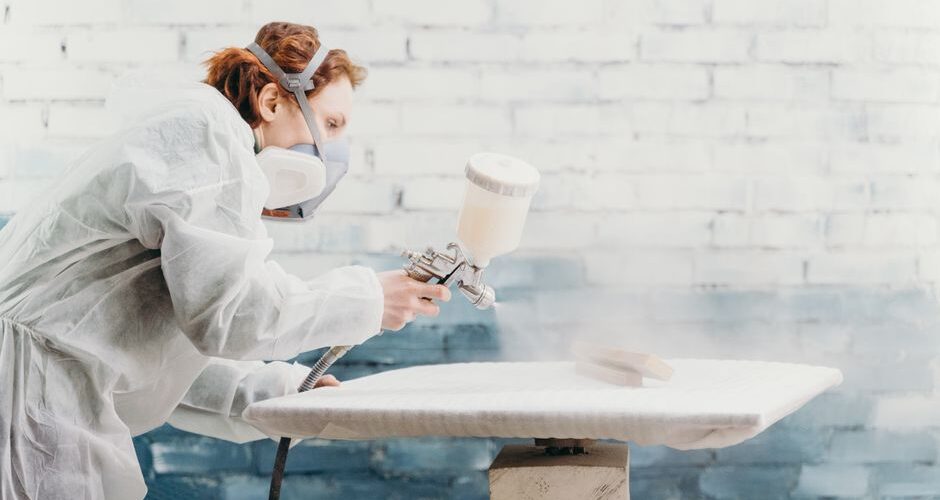
Standard brush or roller applications leave texture and streaks that are immediately visible under kitchen lighting. True factory results require high-volume, low-pressure spray equipment and a dust-free environment. In Colorado’s dry climate, temperature swings and low humidity can affect drying times and adhesion, making professional technique even more critical.
A contractor who understands how to adjust for altitude and arid conditions will produce a finish that lasts.
Refinishing with a factory-quality result typically costs 30 to 50 percent less than full cabinet replacement, while adding comparable visual value to the home. For Colorado homeowners looking to maximize return on investment before selling or simply to enjoy a high-end kitchen without the high-end price tag, this approach makes financial sense.
What Sets Cabinet Refinishing Contractors with Factory Finish Results Apart
Not every painting contractor can deliver a factory finish on cabinets. The difference comes down to process, equipment, and materials. Here is what separates the top-tier providers from the rest.
Prep is everything. The best contractors spend 60 to 70 percent of the project on cleaning, degreasing, sanding, and priming, not on painting. Cabinets that have been exposed to years of cooking grease, hand oils, and steam will reject new coatings unless every trace of contamination is removed. A contractor who rushes through prep is guaranteeing failure down the road.
Spray booth or controlled environment. To achieve a factory finish, professionals either build a temporary spray tent on-site using plastic sheeting and ventilation fans, or they remove doors and drawers entirely and transport them to a dedicated spray area. Spraying in an open kitchen without containment leads to overspray on floors, countertops, and appliances, plus dust nibs embedded in the wet finish.
Premium coating systems. Look for contractors using conversion varnish, catalyzed lacquer, or two-component polyurethane. These are not products you buy off the shelf at a home improvement store. They are professional-grade coatings that chemically cure to a hard, chemical-resistant film. Some contractors describe their system as offering two-component performance from a single-component system, which simplifies application without sacrificing durability.
Color consultation and sample matching. Top-tier providers offer in-home color consultations with brands like Benjamin Moore or Sherwin-Williams, bringing physical samples so you can see how a color reads under your actual kitchen lighting. This step prevents the disappointment of a finish that looked perfect on a tiny chip but feels wrong across an entire kitchen.
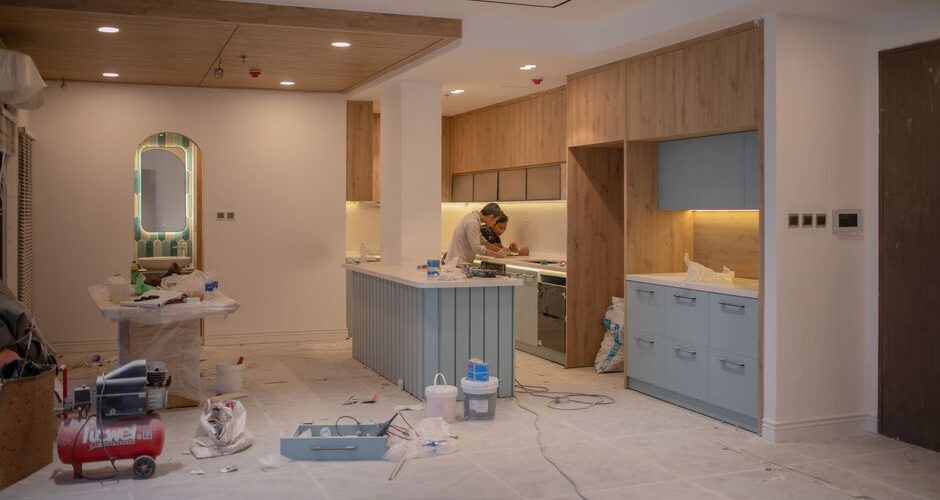
Clean job site promise. Factory-finish pros mask off adjacent surfaces, use dust containment systems, and leave the kitchen livable during the project.
Benjamin Moore Advance – Best for Denver Cabinets
They remove hardware carefully, label every door and drawer, and treat your home with respect from start to finish.
The 6-Step Process Behind a True Factory Finish
Understanding the process helps you ask the right questions when interviewing contractors. Here is what a legitimate factory-finish refinishing job looks like, step by step.
Step 1 – Deep Cleaning and Degreasing
Kitchen cabinets accumulate cooking grease, oils, and grime that prevent adhesion. No amount of sanding will fix a greasy surface; it simply pushes the contamination deeper into the wood. Professional-grade degreasers and TSP substitutes are used to strip every trace of residue. This step alone can take an entire day for a large kitchen, and it is non-negotiable.
Step 2 – Precision Sanding and Surface Prep
All surfaces are sanded to remove the existing sheen and create a mechanical bond for the primer. This is not a rough scuff-and-go. Edges, corners, and detailed millwork are hand-sanded to avoid rounding over profiles. The goal is a uniformly dull surface with no glossy spots remaining. Dust is then vacuumed and tack-clothed away before priming begins.
Step 3 – High-Adhesion Priming
A bonding primer, often shellac-based or urethane-based, seals the wood and blocks stains or tannins from bleeding through the finish coat. Primer is applied via sprayer for a thin, even coat that does not obscure wood grain or detail profiles. This layer is the foundation of the entire finish, and cutting corners here leads to peeling and chipping within months.
Step 4 – Multiple Sprayed Coats of Premium Paint or Lacquer
Two to three coats of a cabinet-grade coating are applied, with light sanding between coats to ensure intercoat adhesion. The spray technique ensures zero brush marks, orange peel, or drips. Each coat is applied at the correct mil thickness: too thin and the finish lacks durability, too thick and it may crack or sag. This is where experience and proper equipment make the visible difference.
Step 5 – Doors, Drawers, and Hardware Coordination
Doors and drawers are finished separately from cabinet boxes to avoid overspray and to ensure every edge and corner receives full coverage. Hardware is either removed, cleaned, and reinstalled or replaced entirely for a cohesive look. New knobs and pulls can modernize the kitchen dramatically for a modest additional investment.
Step 6 – Curing, Reassembly, and Final Inspection
Coatings are allowed to cure fully, not just dry to the touch, before reinstallation. Full cure can take several days to a week depending on the product and Colorado’s humidity levels. A final walkthrough checks for smoothness, color consistency, and proper door and drawer alignment. Any touch-ups are addressed before the job is considered complete.
How to Vet Cabinet Refinishing Contractors in Colorado
Choosing the right contractor requires more than reading a few online reviews. Here is a practical checklist for Colorado homeowners.
Ask about their spray setup. Do they use a dust-free spray booth or a temporary tent? Do they spray on-site or off-site? A contractor who cannot describe their containment and ventilation strategy is not equipped for factory-finish work.
Request a detailed written process. A contractor who can describe their 5- or 6-step process in writing, with specifics about products and drying times, is far more likely to deliver consistent results than one who offers vague assurances.
Check for before-and-after photos. Look for images that show the same lighting and angles, not stock photos or heavily edited portfolio shots. Real project photos reveal the true quality of the work.
Read reviews for finish quality specifically. Generic five-star reviews are less useful than mentions of smooth finish, no brush marks, or looks like new cabinets. Search reviews for keywords that matter to you.
Verify insurance and warranty. Factory-finish work should come with a warranty against peeling, cracking, or yellowing, typically spanning two to five years. A contractor unwilling to stand behind their work is a red flag.
Common Mistakes That Ruin a Factory Finish (and How to Avoid Them)
Even well-intentioned projects can go wrong. Here are the most common pitfalls and how to steer clear of them.
Skipping the degreasing step. Grease left on cabinets will cause the paint to fisheye or peel within months. If a contractor tells you degreasing is unnecessary or that sanding alone is enough, find someone else.
Using wall paint instead of cabinet-grade coatings. Wall paint is too soft for high-touch surfaces and will chip, stain, or become sticky in humid conditions. Cabinet-grade coatings are formulated to withstand daily contact, cleaning products, and temperature changes.
Rushing drying times. In Colorado’s dry climate, paint can feel dry to the touch but still be soft underneath, leading to dents and scratches when doors are rehung too soon. A professional respects the full cure schedule.
Painting over hardware or hinges. This looks unprofessional and can cause hardware to stick or fail. Removing hardware before spraying takes more time but produces a vastly better result.
Hiring the lowest bidder. Factory-quality results require time, equipment, and materials that cost more than a quick spray-and-dash. A bid that seems too good to be true almost always is.
Cost vs. Value – Is a Factory Finish Refinish Worth It in 2026?
The average cost to refinish cabinets in Colorado in 2026 ranges from $4,500 to $9,000, depending on kitchen size, door style, and coating type. Full replacement costs $15,000 to $30,000 or more for comparable quality, which means refinishing saves 40 to 60 percent. For many homeowners, that is the difference between affording a kitchen update this year and putting it off indefinitely.
A factory-quality refinish can recoup 70 to 80 percent of its cost at resale, especially in competitive Colorado markets like Denver, Boulder, and Colorado Springs. Buyers notice the difference between a professional spray finish and a DIY paint job, and kitchens remain one of the top factors in home purchase decisions.
Several factors affect the final cost: the number of doors and drawers, the condition of existing cabinets, the complexity of the color change, and whether you choose conversion varnish versus a standard paint system. Cabinets with heavy damage, water stains, or failing joints may require additional repair work before refinishing can begin.
Frequently Asked Questions About Cabinet Refinishing Contractors
What is the average cost to refinish cabinets in Colorado?
Most Colorado homeowners spend between $4,500 and $9,000 for a full kitchen cabinet refinish with factory-quality results. Custom quotes are based on linear footage, door count, and finish type. The only way to get an accurate number is to have a contractor measure your kitchen and assess the condition of your cabinets in person.
How do you get a factory finish on cabinets?
A factory finish requires a six-step process: deep cleaning and degreasing, precision sanding, high-adhesion priming, multiple sprayed coats of premium cabinet-grade coating, separate finishing of doors and drawers, and full curing before reassembly. The keys are spray equipment, a dust-controlled environment, and professional-grade coatings that cannot be purchased at retail stores.
What finish do professional cabinet makers use?
Conversion varnish and catalyzed lacquer are the gold standard for professional cabinet makers. These products chemically cure to form an extremely hard, moisture-resistant film that stands up to kitchen conditions. Two-component polyurethane is another durable option, though it is slightly less hard than conversion varnish. None of these are available in standard paint stores; they require professional application equipment and training.
What cabinet color is outdated in 2026?
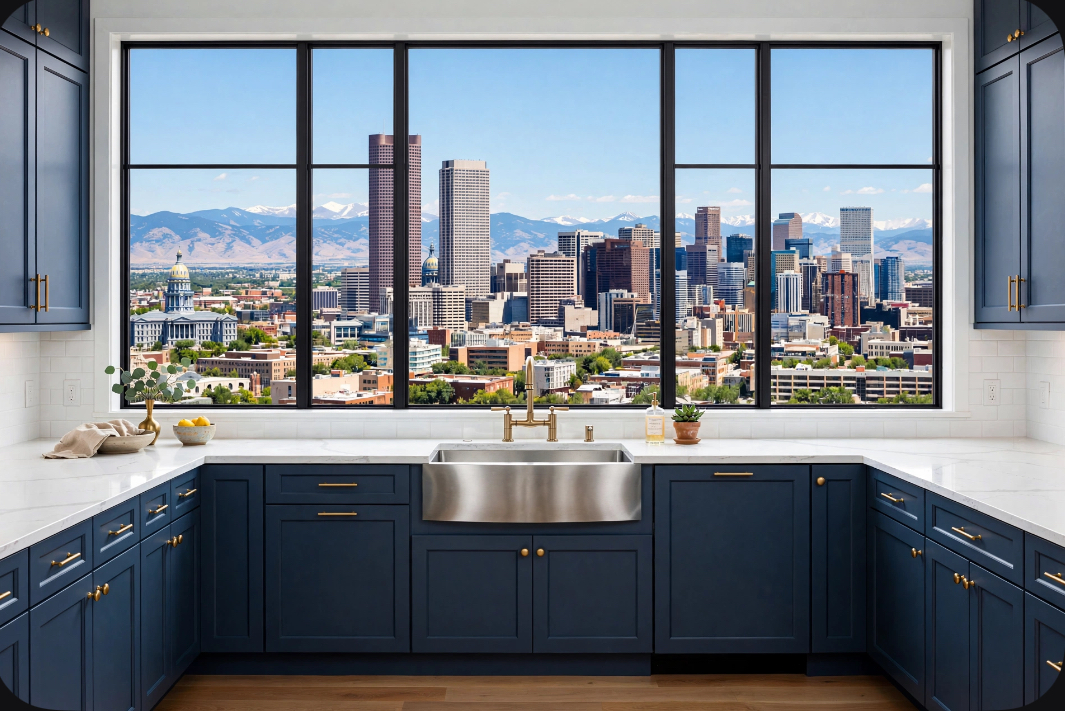
Honey oak and orange-toned wood stains continue to decline in popularity. The trend is moving toward warm white, soft greige, sage green, navy blue, and two-tone combinations that pair a darker island or lower cabinets with lighter uppers. The right color depends on your home’s overall style, natural light, and flooring, which is why an in-home color consultation is so valuable.
Ready to Find Cabinet Refinishing Contractors with Factory Finish Results in Colorado?
A true factory finish comes down to three things: obsessive prep work, a controlled spray environment, and premium coatings applied by experienced hands. When you interview contractors, listen for specifics. Ask about their process, their equipment, and their warranty. Look at real project photos and read reviews that mention finish quality by name.
If you are ready to transform your kitchen without the cost and disruption of a full replacement, Cabinet Painting Colorado offers free in-home consultations with color samples matched to your space. Contact us today to schedule your estimate and see what a factory-quality refinish can do for your home.